



 to add an item to your Itinerary basket.

On Saturday the 17th of October, the Gloucester Civic Trust is holding its annual Apple Day at The Folk of Gloucester on Westgate Street.
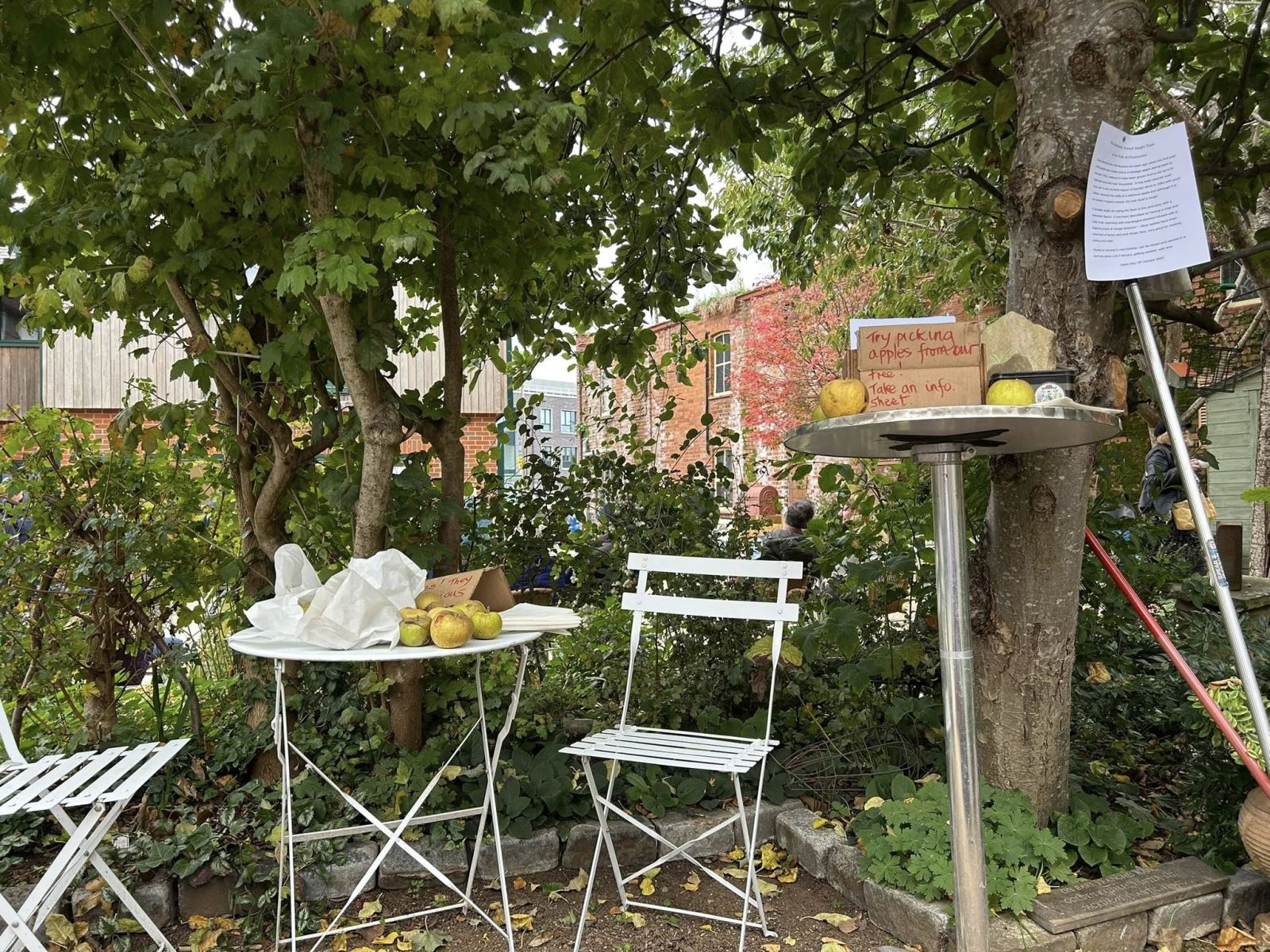
While the main aim is to show off the traditional horse-drawn cider press and have a good old knees-up, part of the reason for the event is to press the apples from a very special historic tree in the venue’s garden.
We think of history as being preserved through ancient documents or objects in museums. But the history of a place can also be found in the plants and animals that live there. For example, Gloucestershire’s Roman Snails are descended directly from the edible snails brought over by its Roman occupiers; and are only found around former Roman settlements such as Leckhampton Hill and Chedworth Roman Villa.
So it’s no surprise that around 25 years ago, when 99-103 Westgate Street was still Gloucester Folk Museum, they decided to plant in its garden a tree that encapsulated Gloucestershire’s long history of orchards and cidermaking – and that came from the very centre of Gloucester itself.
At first glance, Ashmead’s Kernel apples aren’t much to look at – their matte, russet skin looks dull and drab next to younger varieties like the Granny Smith and Golden Delicious. But it’s their sweet, sharp flavour that makes them stand out. An apple connoisseur once described them as: 'having a crisp and nutty snap, exploding with champagne-sherbet infused with a lingering scent of orange blossom'. But most people find it more like lemons or pear drops.
It’s this distinctive taste that has made the Ashmead’s Kernel prized since the 1700s a cooking apple, a cider apple and a straightforward “eating apple”. The hardy tree even won the RHS Award of Garden Merit in 1993.
But where did it come from? Well, the “kernel” part of its name probably refers to the fact that it was discovered as a chance seedling of unknown parentage rather than being selectively bred. Meanwhile, “Ashmead” is the name of the person in whose garden it was first cultivated – but which Ashmead?
Historical records of the apple refer to both a Mr. Ashmead and a Dr Ashmead. Mr. William Ashmead was a lawyer said to have grown his eponymous tree in the early 1700s from a pip in the garden of Ashmead House, Eastgate Street, Gloucester, which is now the site of King’s Walk Shopping Centre. The only record of a Dr Ashmead in Gloucestershire was a surgeon in Cheltenham, who probably wouldn’t have had the space to grow trees – a long-ago historian probably conflated the two men in error.
But regardless of its origin, it’s where the tree ended up that’s truly amazing. Ashmead’s Kernel was one of the apple varieties taken over to America by colonisers on the Mayflower. While most of the English varieties couldn’t survive the harsh climate of the Americas, Ashmead’s Kernel thrived and became one of the first successful apples of the New World. You can even picture it in the pockets of American folk hero Johnny Appleseed as he planted orchards across Canada and the USA.
The original tree at Ashmead House survived for more than a hundred years before being felled to make way for building works. Today, its descendent at The Folk of Gloucester is lovingly tended by volunteer gardeners and pruned by staff from Severn Cider. It frequently produces a bumper crop and forms the focal point of Apple Day in October, as well as the traditional apple tree Wassail ceremony in January.
While the breed has now been taken over by faster-growing, more commercially viable varieties, Ashmead’s Kernel holds a unique place in Gloucestershire’s history that is just as worthy of preservation as any priceless museum artefact.
Apple Day 2026 takes place from 10am – 4pm on Saturday the 17th of October at The Folk of Gloucester, 99-103 Westgate Street, GL1 2PG. Featuring live music, Morris dancing, food and drink, kid’s craft activities and market stalls, there’s something for all ages. Entry is by donation on the door, with all funds supporting the upkeep of The Folk of Gloucester’s historic buildings and wide variety of community events.
Find out more at: https://www.gloucestercivictrust.org/the-folk-home/
Related
Comments
Comments are disabled for this post.
